Tomographic method development
Generalized Differential Ambient Noise Tomography
A seismic imaging method I developed to combine ambient noise measurements into constraints focused on a chosen region of the subsurface.
- Inverse Problems
- Ambient Noise
- Synthetic Benchmarks
Research question
Can we design combinations of ambient noise measurements that retain sensitivity to a target while reducing unwanted sensitivity and shared errors?
Study design
I developed generalized differential ambient noise tomography (GDANT), from its mathematical formulation through implementation and validation. The method chooses weighted combinations of measurements across paths and frequencies so their combined sensitivity emphasizes a chosen subsurface target.
I evaluated the method with synthetic recovery tests, noise and source-bias experiments, and a field application along the BASIN array in Southern California.
Key findings
GDANT improves recovery in the noisy synthetic tests
With 5% added noise, GDANT had the lowest average normalized model error among the four approaches tested. For the noise-free tests, the combined Direct + GDANT approach had the lowest average error.
Field results agree with an independent structural constraint
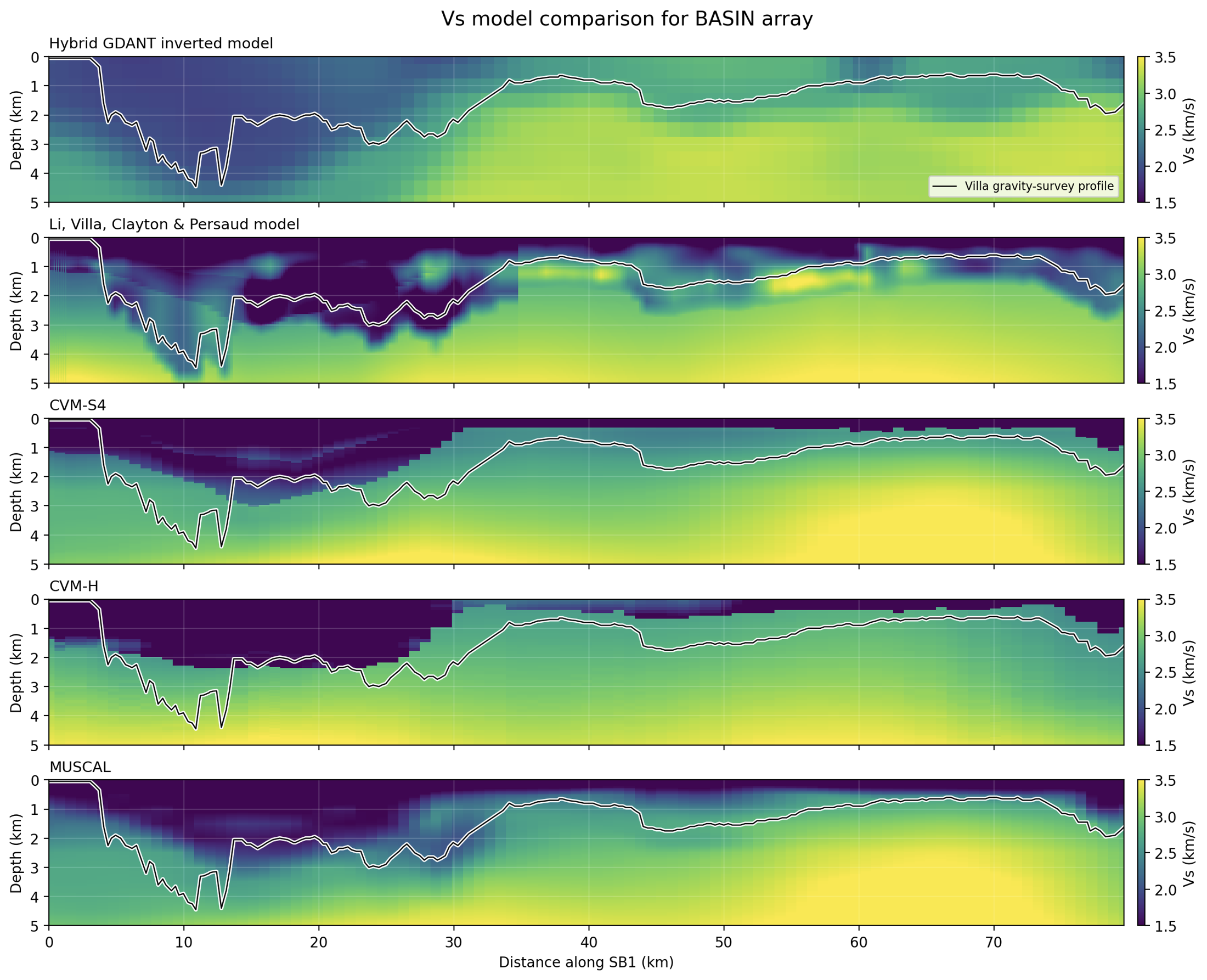
Along the BASIN array’s SB1 profile, the hybrid inversion recovered a deepening low-velocity basin consistent with an independent gravity-derived profile. The gravity result was used for comparison, not imposed on the inversion.
Uncertainty must follow the measurement combinations
Differential measurements can share information. Propagating their covariance is essential to prevent repeated information from being overweighted and to distinguish targeted sensitivity from new independent observations.
Design the measurement around the target
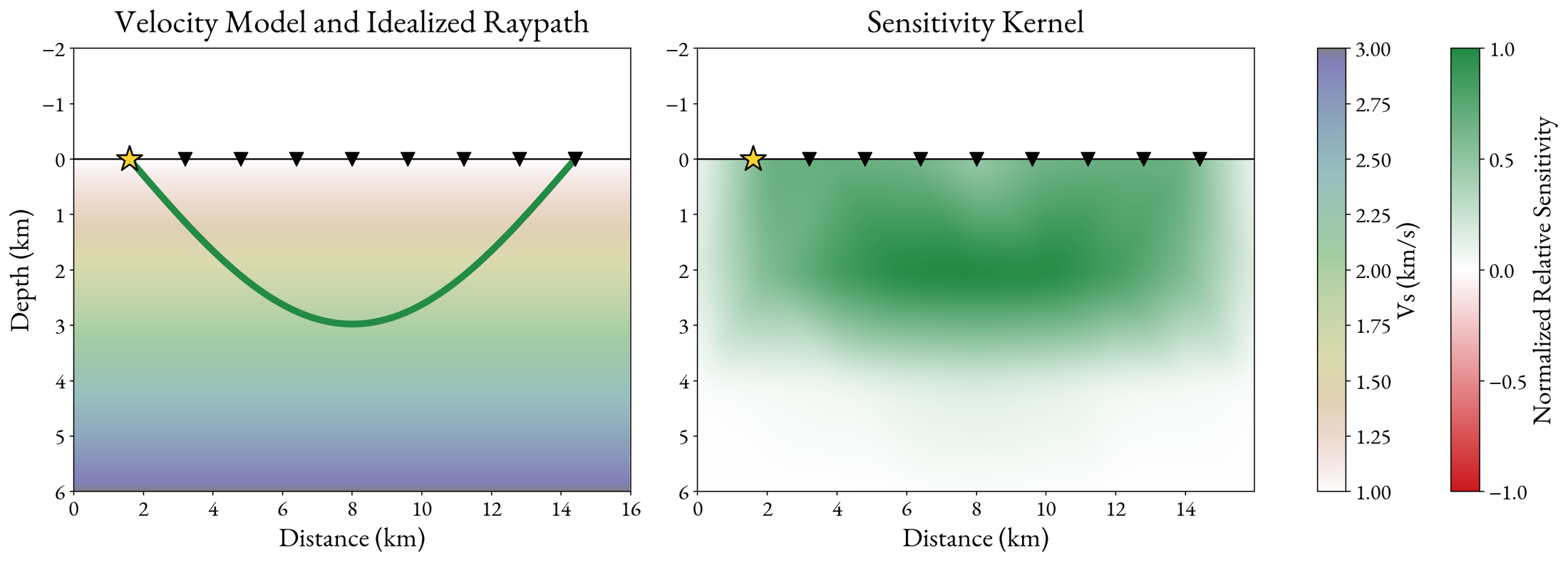
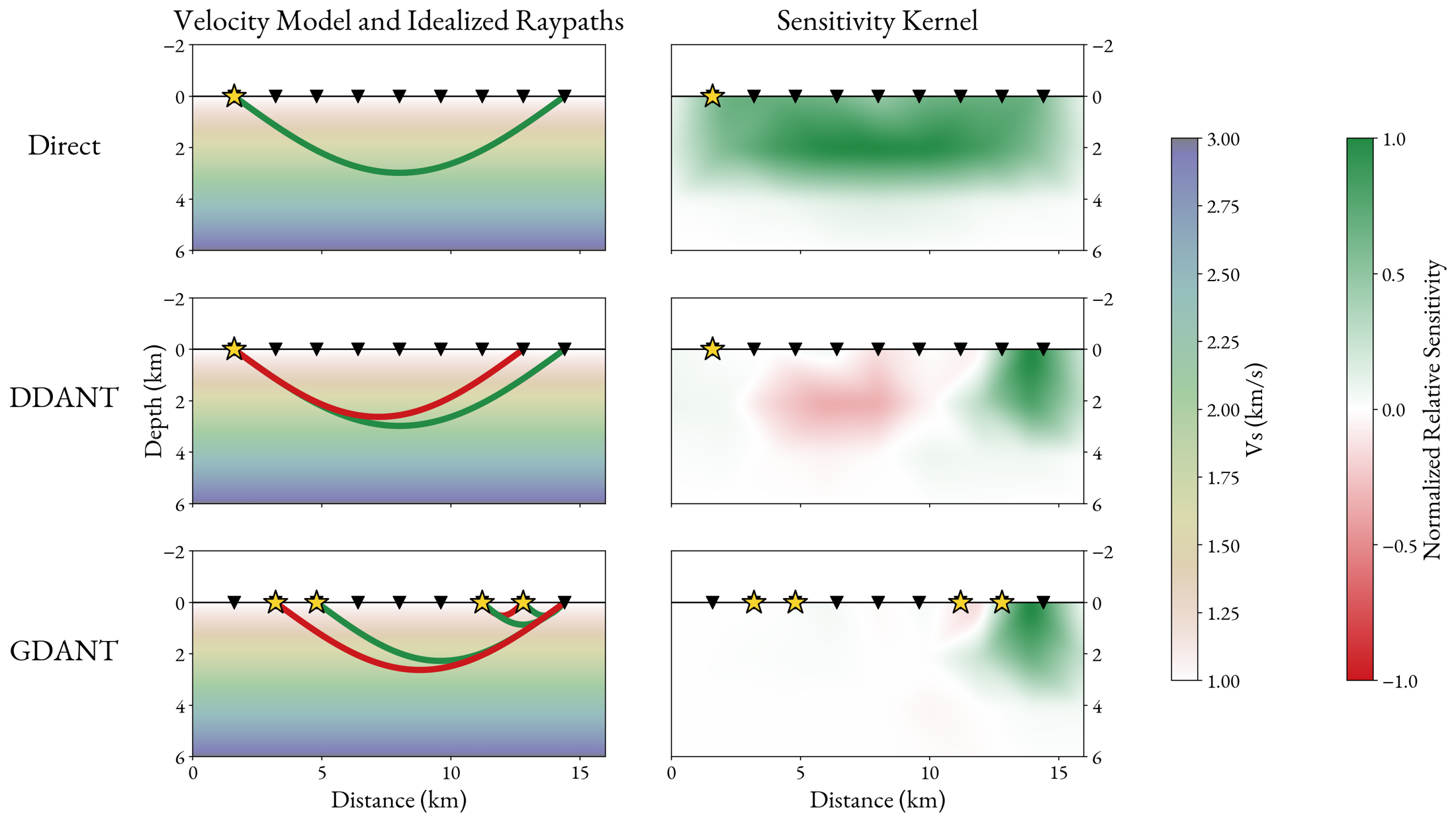
A direct measurement uses one station pair. Double-difference ANT subtracts two measurements sharing a source. GDANT generalizes that idea: it can combine multiple paths and frequencies, choosing their weights to shape the resulting sensitivity.
The animation shows the effective kernel building up as weighted contributions are added. This makes the scientific target part of measurement design.
Test recovery against known synthetic structures
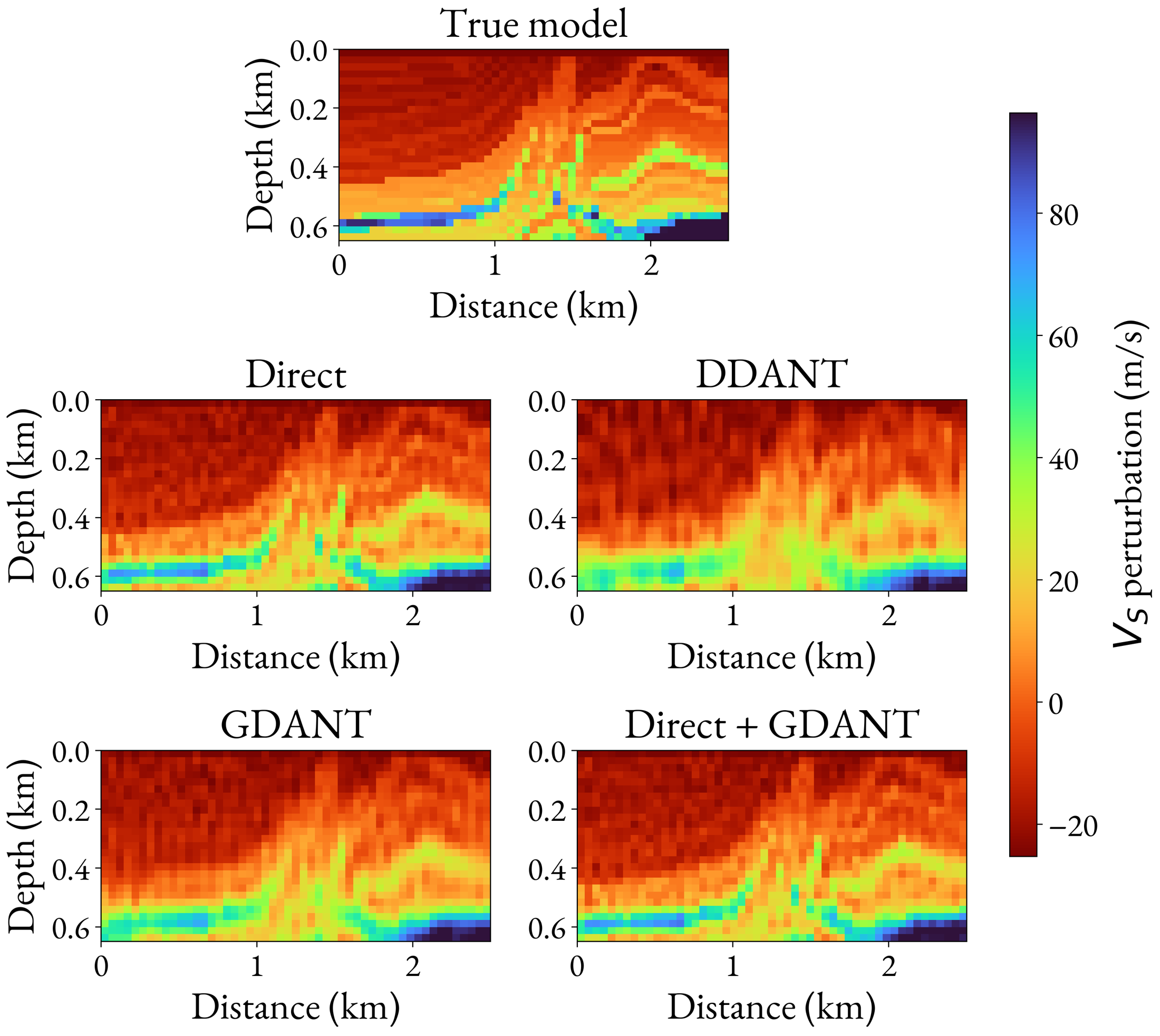
Synthetic models provide a known answer against which to measure recovery. The example below compares direct ANT, DDANT, GDANT, and the hybrid Direct + GDANT inversion on the same structure.
Across the synthetic tests, GDANT’s average normalized root-mean-square error was 0.1617 with 5% noise, compared with 0.2640 for direct ANT. In the noise-free case, Direct + GDANT and direct ANT were nearly tied. These comparisons distinguish performance with clean measurements from performance after noise is introduced.
| Method | No added noise | 5% noise |
|---|---|---|
| Direct | 0.1170 | 0.2640 |
| DDANT | 0.1979 | 0.2104 |
| GDANT | 0.1507 | 0.1617 |
| Direct + GDANT | 0.1166 | 0.2693 |
Compare field recovery with independent gravity data
Along the BASIN array’s SB1 profile, the hybrid inversion recovers deep low-velocity basin structure that is consistent with an independent gravity-derived profile. That gravity constraint was used to evaluate the result, rather than being imposed in the inversion.
The comparison with existing velocity models shows how the targeted inversion adds detail to the basin geometry.
Detailed methods
Optimize the measurement weights
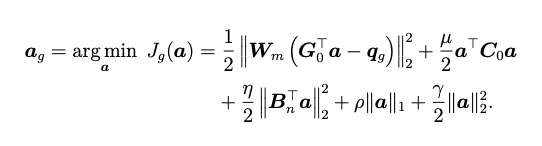
The objective function balances five terms. Target matching makes the combined kernel resemble the desired spatial pattern. A covariance term penalizes amplification of measurement noise. A nuisance-mode term suppresses effects shared by sources or receivers. Sparsity favors combinations that use fewer measurements, and a coefficient-size penalty keeps the weights stable.
The weights therefore control both where a measurement is sensitive and how errors propagate into it.
Compare direct and differential sensitivity
Direct ANT, fixed double differences, and GDANT operate on the same underlying measurement bank but form different effective kernels. The comparison shows how combining paths changes the volume sampled by each observation. Frequencies add a further way to vary depth sensitivity.
Carry covariance into the inversion
Weighted combinations can share measurements and therefore share errors. I propagate the measurement covariance into the designed rows so repeated information receives appropriate weight. Hybrid inversions retain direct observations alongside GDANT rows to preserve absolute constraints while adding the targeted differential measurements.
Why it matters
GDANT makes measurement design part of the imaging problem. It provides a way to tailor the available seismic information to a specific structural question while explicitly accounting for shared errors and uncertainty.